Use two uploaded images with a clear separation of their roles:
Reference No. 1 — the original photo. Use it for composition, the arrangement of characters, poses, proportions, angle, and the overall idea of the photo.
Reference No. 2 — a photo of the person who needs to be placed in the final scene. Use it to accurately reproduce the appearance, face, hairstyle, and clothing..
1. The main task.
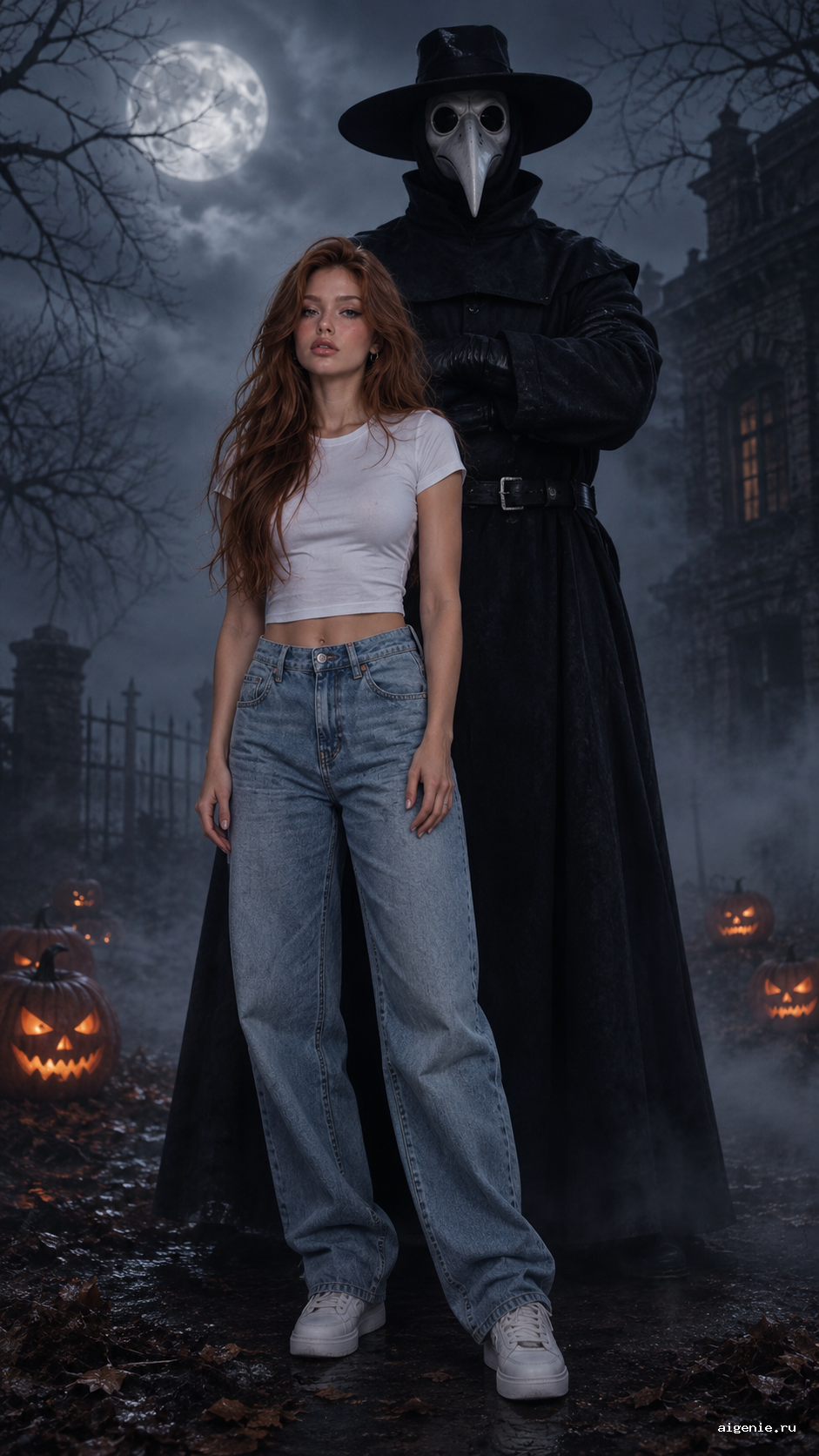
Recreate the photo from the first reference, preserving the main composition: in the foreground, there is a person, and directly behind them stands a very tall character in a Plague Doctor costume.
At the same time, completely replace the person from the first image with the person from the second reference.
Do not mix the appearances of the two people. Do not use the face, hairstyle, or individual features of the person from the first image. The only source of the appearance of the character in the foreground should be the second reference.
2. Appearance and identity of a person
.
Transfer the person’s appearance from the second reference as accurately as possible..
Preserve:
individual facial features and geometry;
.
the shape of the eyes, nose, lips, eyebrows, and chin;
.
the hairstyle, length, and color of the hair;
.
skin tone;
.
body build and natural proportions;
.
characteristic features of the appearance.
The person must remain recognizable and look like the same person from the second image..
Do not artificially enhance the appearance, do not change the age, do not make the face look model‑like, and do not create an average appearance..
3. The person’s clothing.
.
Determine the clothing based on the second reference..
If the person’s clothing is clearly visible in the photo, transfer it as accurately as possible: preserve the style, color, material, prints, logos, accessories, and cut features.
If the clothing in the reference is missing, not fully visible, or cannot be identified, independently generate a suitable casual look in a dark color scheme: a black or dark gray hoodie, a T‑shirt, dark trousers, and sneakers.
If the person in the second reference is wearing light‑colored clothing, do not artificially перекрашивать it. The priority is to preserve the original look.
4. The Plague Doctor character
Behind the person, there must be a very tall and imposing Plague Doctor.
His height should be significantly greater than that of the front character — approximately 1.4–1.5 times taller. He looks like a huge, gloomy figure towering over the person.
Appearance:
wide-brimmed black hat;
the white mask of the Plague Doctor with a distinctive long beak;
deep black eye sockets;
black high collar covering the neck;
A long, massive black raincoat almost reaching the ground;
wide sleeves;
black belt at the waist;
massive black boots.
Pose: The Plague Doctor stands directly behind the man, slightly shifted to the right. The arms are crossed over the chest. The head is directed straight at the camera. He should not interact with the person or block their face.
Maintain the impressive difference in height. The Plague Doctor should look physically much taller, broader‑shouldered, and more massive.
5. Composition and arrangement
Vertical photo, 9:16 aspect ratio.
Full height of both characters. The person is in the foreground, slightly to the left of the center of the frame. The Plague Doctor is standing directly behind him, occupying the right and central parts of the composition.
The man is looking straight at the camera. His facial expression is calm and serious, without a smile. His arms are hanging loosely by his sides.
The Plague Doctor is standing motionless, with his arms crossed over his chest. His head and hat are significantly higher than the man’s head.
The camera is positioned approximately at the man’s chest level. Use a realistic perspective, without distorting the proportions.
6. Gloomy Halloween background
Completely replace the original environment with an atmospheric location in the style of Halloween Horror.
In the background:
a dark old building or abandoned structure;
bare tree branches;
thick fog creeping along the ground;
a large full moon behind the clouds;
several glowing pumpkins with carved, sinister faces.
Dark, damp ground with fallen leaves;
barely noticeable silhouettes of trees and buildings in the background..
The atmosphere should be unsettling, mysterious, and cinematic. Don’t turn the scene into a cartoon or a bright, festive illustration.
7. Lighting and color correction.
Gloomy, cold lighting with a predominance of dark blue, graphite, and black tones.
Moonlight creates cold highlights on the Plague Doctor’s hat, mask, and shoulders.
Pumpkins emit small warm orange light sources near the ground. Fog gently diffuses the light and adds depth to the scene.
The characters should be clearly distinguishable against the dark background. Don’t darken the faces and clothing to the point where details are completely lost.
8. Photographic style
Maximum photorealism. The frame should look like a professional staged photograph for a horror poster.
Realistic textures of skin, hair, clothing, cloak fabric, and mask. Natural shadows, correct anatomy, physically accurate proportions and perspective.
Cinematic color correction, high detail, moderate depth of field, realistic optics.
9. Strict restrictions
Do not alter the identity and face of the person from the second reference.
Do not use the face from the first reference.
Do not mix the appearances of two people.
Do not change the clothing from the second reference if it is visible.
If the clothing is not visible, generate it yourself.
Do not change the appearance of the Plague Doctor.
Do not reduce his height.
Do not replace the mask with another one.
 ChatGPT Image
 ChatGPT Image
 ChatGPT Image